Planetary atmospheres, climate and magnetism.
I study how physical processes shape planetary atmospheres, climates and observable properties. My work combines atmospheric dynamics, magnetohydrodynamics and numerical modelling.
Magnetic fields, flows and perturbations in hot Jupiters
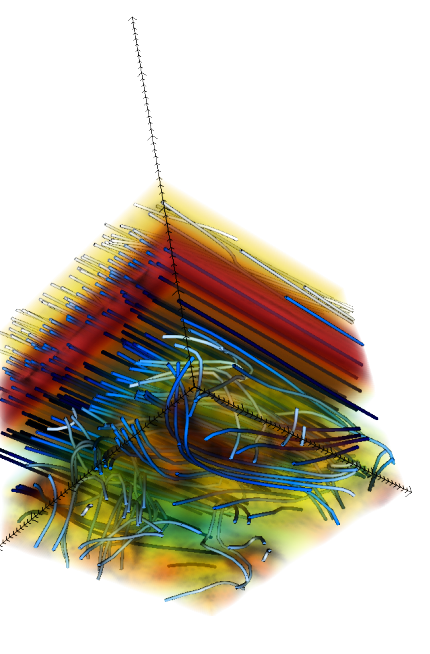
I investigate how atmospheric flows, magnetic fields and perturbations interact in hot and ultra-hot Jupiters. These highly irradiated planets host fast, strongly stratified atmospheric flows whose interaction with magnetic fields can generate currents, modify the circulation and lead to substantial energy dissipation.
Using local three-dimensional magnetohydrodynamic simulations, I study magnetic-field winding, turbulent motions and non-ideal effects such as Ohmic diffusion, Hall drift and ambipolar diffusion. I am particularly interested in how imposed or naturally developing perturbations alter the magnetic-field structure, current systems, atmospheric dynamics and energy transport. This provides a way to connect small-scale atmospheric processes with observable consequences and with the broader problem of how hot-Jupiter atmospheres evolve.
Associated papers:
- Clàudia Soriano Guerrero, Daniele Viganò, Rosalba Perna, Taner Akgün and Carlos Palenzuela, Magnetic winding and turbulence in ultra-hot Jupiters, Monthly Notices of the Royal Astronomical Society, 525, 626–641 (2023).
- Clàudia Soriano Guerrero, Daniele Viganò, Rosalba Perna, Albert Elias-López and Hayley Beltz, Non-ideal MHD simulations of hot Jupiter atmospheres, Monthly Notices of the Royal Astronomical Society, 540, 1827–1843 (2025).
- Clàudia Soriano Guerrero, Daniele Viganò, Rosalba Perna, Thomas Celora, Albert Elias-López and Hayley Beltz, Influence of turbulent perturbations in the magnetised atmospheres of Hot Jupiters, submitted to Astronomy & Astrophysics (2026).
Collaborators: Daniele Viganò, Rosalba Perna, Taner Akgün, Carlos Palenzuela, Albert Elias-López, Hayley Beltz and Thomas Celora.
Global circulation models
I use global circulation models to investigate the large-scale dynamics and climate of planets and exoplanets. These models describe the evolution of atmospheric winds, temperature, waves, radiative forcing and heat transport.
Using global circulation models such as THOR and OASIS, I investigate planetary atmospheres across different physical regimes. This work currently includes superrotation in Earth-like planets, as well as collaborations on early Venus atmospheres, hot Jupiters and Hycean worlds.
Associated papers and projects:
- Clàudia Soriano Guerrero, João M. Mendonça and Ryan Boukrouche, Superrotation as a Coupled Energetic–Dynamical Transition, in preparation.
- João M. Mendonça and Niku Madhusudhan, with Clàudia Soriano Guerrero as a co-author, OASIS modelling of Hycean worlds, including K2-18 b, in preparation.
- Ryan Boukrouche and collaborators, Runaway atmospheres on terrestrial planets, with Clàudia Soriano Guerrero as a co-author, in preparation.
Early-stage collaborations: Millie Smith, on hot-Jupiter GCMs; Alice Davis, on early Venus atmospheres.
Connecting atmospheres with planetary interiors
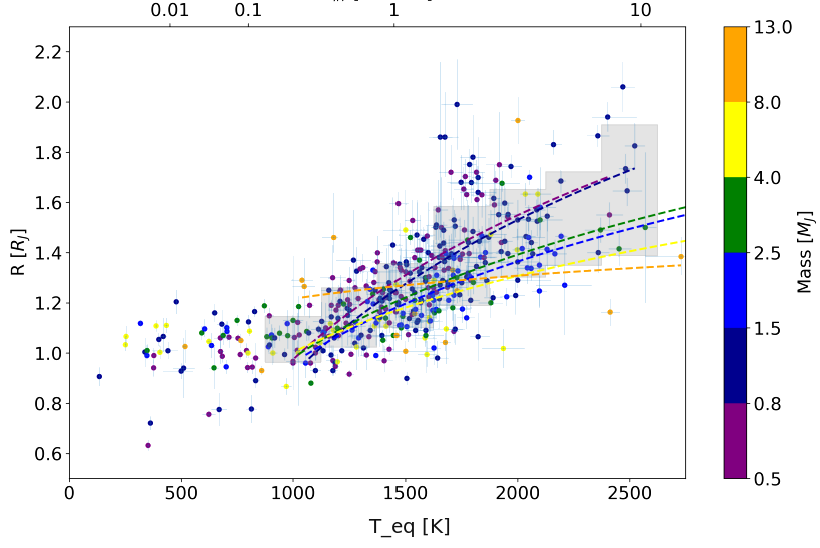
This line connects atmospheric flows and magnetic induction with the evolution of planetary interiors. I study magnetic dynamos, atmospheric currents and ohmic dissipation, including their possible role in explaining the inflated radii of hot Jupiters. A future direction is the development of coupled atmosphere–interior models.
Associated papers:
- Daniele Viganò, Soumya Sengupta, Clàudia Soriano Guerrero, Rosalba Perna, Albert Elias-López, Sandeep Kumar and Taner Akgün, Inflated hot Jupiters: Inferring average atmospheric velocity via Ohmic models coupled with internal dynamo evolution, Astronomy & Astrophysics, 701, A8 (2025).
- Albert Elias-López, Fabio Del Sordo, Daniele Viganò, Clàudia Soriano Guerrero, Taner Akgün, Alexis Reboul-Salze and Matteo Cantiello, Planetary Dynamos in Evolving Cold Gas Giants, Astronomy & Astrophysics, 696, A161 (2025).
- Albert Elias-López, Matteo Cantiello, Daniele Viganò, Fabio Del Sordo, Simranpreet Kaur and Clàudia Soriano Guerrero, Rossby number regime, convection suppression, and dynamo-generated magnetism in inflated hot Jupiters, The Astrophysical Journal, 990, 38 (2025), published 22 August 2025, DOI: 10.3847/1538-4357/adf057.
Comparing atmospheric models
CUISINES is a community framework for comparing planetary-atmosphere models using common physical setups, numerical experiments and diagnostics. Its aim is to understand the origin of differences between models and how those differences affect predicted observables.
MOCHA — MOdeling the Circulation of Hot exoplanet Atmospheres — is a CUISINES intercomparison focused on hot and ultra-hot Jupiters. I participate through THOR, contributing to the comparison of circulation, thermal structure and observable predictions.
CAMEMBERT — Comparing Atmospheric Models of Extrasolar Mini-Neptunes Building and Envisioning Retrievals and Transits — is an intercomparison focused on mini-Neptunes and the connection between atmospheric models, transit spectra and retrievals. I participate in CAMEMBERT, contributing to the comparison of atmospheric models and their observable predictions.
Associated papers:
- Nicolas Iro, Duncan Christie, Thomas J. Fauchez, Denis Sergeev, Elspeth K. H. Lee, Emily Rauscher, Nathan J. Mayne, Shang-Min Tsai, John Allen, Yuancheng Xu, Clàudia Soriano Guerrero, Ludmila Carone, Pascal A. Noti, Maria Zamyatina, Thaddeus D. Komacek, Lucas Teinturier, João M. Mendonça, Maria E. Steinrueck, Aaron D. Schneider, Leonardos Gkouvelis, Can Akin, Ian Dobbs-Dixon, Joshua D. Lothringer and Christiane Helling, MOdeling the Circulation of Hot exoplanet Atmospheres (MOCHA) version 1.0: A CUISINES intercomparison project, in preparation.
- CAMEMBERT collaboration, CAMEMBERT: Initial Results from a Mini-Neptune Intercomparison, in preparation. The final author list and order will be added once confirmed.